• Butterflies of Tobago

    Tobago is home to a diverse range of butterfly species. Some of the most commonly observed species on the island include:

    1. The Blue Emperor (Morpho peleides): This large butterfly is known for its brilliant blue wings, which are often visible from great distances. It is found in forested areas throughout Tobago.
    2. The Postman (Heliconius melpomene): This striking butterfly has black wings with bright orange spots and a red stripe. It is found throughout Tobago in a variety of habitats.
    3. The Zebra Longwing (Heliconius charithonia): This species has long, narrow wings that are black with white stripes. It is found in forested areas and gardens throughout Tobago.
    4. The Common Buckeye (Junonia coenia): This butterfly has brown wings with large eyespots that resemble the eyes of a deer. It is found in a variety of habitats throughout Tobago.
    5. The White Peacock (Anartia jatrophae): This species has white wings with black and orange markings. It is found in open areas and gardens throughout Tobago.

    These are just a few of the many butterfly species that can be found on Tobago. The island’s diverse range of habitats, from forested areas to open fields and gardens, provide a home to a wide variety of butterfly species.

  • Birds of Tobago

    Tobago is home to a rich diversity of bird species, including both resident and migratory species. Some of the most commonly observed bird species on the island include:

    1. The Rufous-tailed Jacamar (Galbula ruficauda): This striking bird is found in Tobago’s forests and woodlands. It has a long, curved bill and a bright, iridescent green body.
    2. The Blue-crowned Motmot (Momotus momota): This distinctive bird is found in Tobago’s forested areas. It has a bright blue crown and a long, racket-shaped tail.
    3. The White-tailed Sabrewing (Campylopterus ensipennis): This hummingbird species is found in Tobago’s forests and gardens. It has a distinctive, curved bill and a metallic green body.
    4. The Red-billed Tropicbird (Phaethon aethereus): This seabird species is found along Tobago’s coasts. It has a striking red bill and long, white tail feathers.
    5. The Yellow-headed Caracara (Milvago chimachima): This bird of prey is found in open areas throughout Tobago. It has a distinctive yellow head and black body.
    6. The Magnificent Frigatebird (Fregata magnificens): This large seabird is found along Tobago’s coasts. It has a distinctive, angular wingspan and a bright red throat pouch.

    Tobago is also home to several species of parrots, including the endangered Trinidad and Tobago endemic species, the Trinidad piping-guan. Other notable species include the white-necked jacobin, collared trogon, and the yellow-bellied elaenia. Tobago’s Main Ridge Forest Reserve is an excellent place to observe a variety of bird species in their natural habitat.

    These are just a few of the many bird species that can be found on Tobago. The island’s diverse range of habitats, from forests and woodlands to coastal areas and open fields, provide a home to a wide variety of bird species.

  • |

    Hillsborough Reservoir

    Hillsborough Reservoir, which was commissioned in May 1952, by His Excellency Sir Hubert Elvin Rance, then Governor of Trinidad and Tobago, is the only impounding reservoir in Tobago.

    The reservoir is located 870 feet above sea level, Hillsborough has a rustic beauty and an elegantly designed spillway which provides a safety outlet when the reservoir is too full. The reservoir has a maximum storage capacity of 1.02 million m³ and the water treatment plant located just below can produce up to 9,091m3 per day.
    Water from the reservoir serves areas such as Mt. St. George, Concordia, Whim, Mary’s Hill, Union and Les Coteaux.

    The raw water from the reservoir passes through two strainers that clear the incoming water of large debris such as branches, twigs and leaves before entering the chemical house. Aluminium sulphate (alum) is added to make the suspended particles of silt and mud in the water coagulate and form large and heavier particles that sink to the bottom of the sedimentation (or settling) basins. The water is then filtered through layers of sand and gravel, a process that removes fine particles still in the water. The final stage of the water treatment process is the addition of lime, to counteract the acidity of the water and the injection of chlorine to destroy any disease-causing bacteria.

    Construction of the Hillsborough Dam significantly changed the landscape but the catchment area and the reservoir still teem with an abundance of wildlife and a variety of flora.
    There are twenty-eight (28) species of birds documented at Hillsborough which will excite the interest of any bird watcher.

    WASA

  • Districts of Tobago

    Tobago was previously divided into seven (7) parishes while under colonial rule. 

    • Saint Patrick
    • Saint Andrew
    • Saint David
    • Saint George
    • Saint Mary
    • Saint John
    • Saint Paul

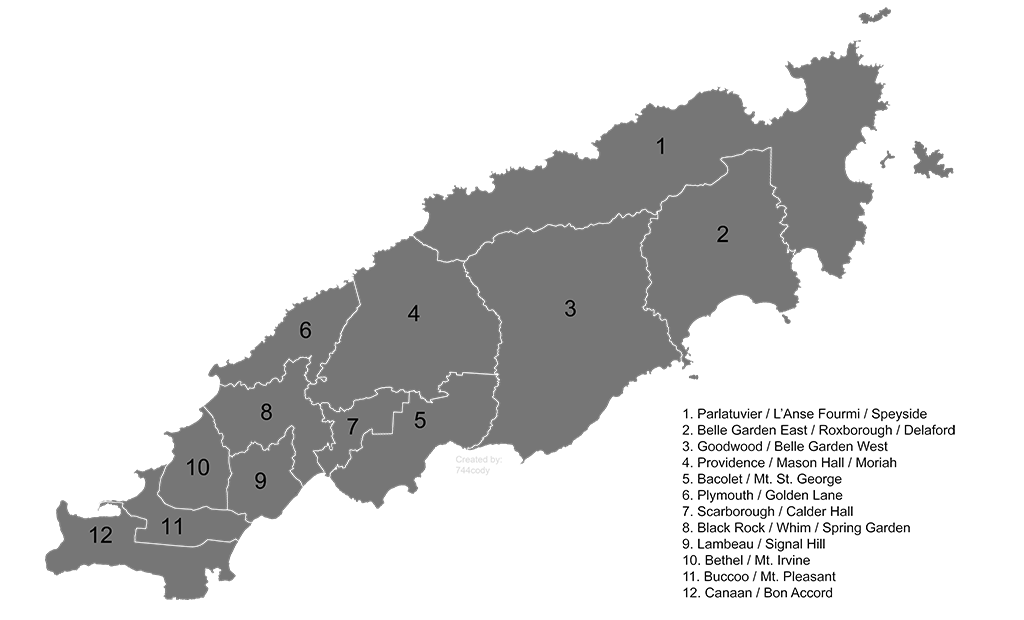
    In 1980 the Tobago House of Assembly replaced this system with twelve (12) local electorial districts and seats in the assembly.

    • Bacolet/Mt. Saint George
    • Goodwood/Belle Garden
    • Bethe/Mt. Irvine
    • Black Rock/Whim/Spring Garden
    • Buccoo/Mt. Pleasant
    • Canaan/Bon Accord
    • Lambeau/Signal Hill
    • Parlatuvier/L’Anse Fourmi/Speyside
    • Plymouth/Golden Lane
    • Providence/Mason Hall/Moriah
    • Belle Garden East/Roxborough/Deleford
    • Scarborough/Calder Hall

    In 2021 an additional 3 seat were added making it 15 electorial districts.

    Tobago is comprised of 15 electorial districts that are represented by seat in the Tobago House Of Assembly.